Thursday, 15 March 2012

May – August, 2003: Passport Page 1 & 2 - Australia

Introduction

Some time ago as I was walking along the Thames River on the way to meet a friend, I began to think about the things which needed to be done over the coming weeks, and one of the main tasks was to send off for a new passport. My current one was in condition that gave me trouble entering foreign countries. But, not to worry, for all the grief I received, it was equally reciprocated by my own country, the U.S.

It took almost 9 years to beat and shred the passport to its state whether through the washing machine, blinding Brazilian mist and dense mud,  Swiss snow, oppressive Australian sun and sea, freezing English rain, mind numbing Slovenian gales, Spanish botellones, Patagonian expeditions, Moroccan bush, and the rough and tumble back pocket of my jeans. It has been through its test, survived and, now, retired.

On my way to put the document to rest, I took it out one last time to look at all it had been through. As I flicked past the blue, frayed and tattered cover and began looking through each of the worn pages, I started to realize what a journey it had been on. Over the past 9 years, a collage of stamps had been littered over 54 pages and, in doing so, left a trail crossing 5 continents, over 30 countries, encountered a collection of some of the best people in world from so many different backgrounds and generated memories that have and will continue to propel my soul to the place it eternally longs for and will never cease searching for again, again and again.

Each page, unequivocally, owns a unique memory, person or group of friends, a memorable place, an adventure and, ultimately, a place in my heart that will forever bring tears of happiness to my eyes for the life and friends that I´ve been so fortunate to have. As I go through, what I consider to be, my life´s journey up until now, I want to sit down and memorialize a selected memory from each page of my passport in an effort to crystalize and record the amazing times we´ve shared over such a short period. Even more importantly, such an endeavor, I would hope, will ultimately serve and remind us of the opportunities we are so fortunately given and to take of advantage of them as you never know when they´ll pass you by again.

So, on we go….


May – August, 2003: Passport Pages 1 & 2 - Australia

To this day, I can remember the genesis of the idea, which started, for better or worse, the insatiable desire to travel as far as the mind will permit.

It was in the University of Georgia library in Athens while ostensibly there to study. For what? It wasn´t important whatever it was since the idea hatched that day has undoubtedly led me to where I am today.

It was the beginning of our sophomore second semester, and I was there with a group of four or five friends pondering what we could do over the upcoming summer. There was the usual talk of going to the beach and finding work, perhaps doing a road trip to Bonnaroo or doing summer school – to name a few. However, the most compelling and seemingly far-fetched idea that emerged was to head to Australia, find work and live in a city like Melbourne or Sydney - the only two places we had even heard of at the time.

So then and there, the research began. I can vividly remember the dreams of immaculate luxury we thought we´d be able to afford given the strength of the greenback relative to the Aussie dollar. We envisaged renting beautiful condos perched in the center of Melbourne or Sydney with sun drenched pools, living a stone´s throw from the beach, surrounded by American crazed women and, who gives a damn, it was Australia!

It was going to be an adventure fit for kings, Australian beer (probably Fosters) and the all too obvious kangaroos, koalas and “crocs.” Of course, this was ignoring the fact we did not have jobs even remotely close to arranged, much less even started considering. As the journey unfolded, we could not have been further from the truth except for the beer (but not Fosters).

Unlikely where you think it would be....
As the trip began to materialize with the visa process and rounding out the cost, the number of interested and disillusioned fell down from five to four and then there were three left at the end. John Fleming, Wes Conner and me (and eventually my brother Jackson).


After considerable research and whimsical dreaming, the final plan was a cinch and as follows:
  • Fly 24 hours, halfway across the world to a place we had never been. Like taking candy from a baby.
  • Arrive in Sydney, get our bearings straight over 2 days and buy a second hand car. Ok, slightly more complicated but easy enough. We can drive – never mind it will be on the left side of the road.
  • Drive north, no particular destination in mind, and find a suitable home for 6 – 8 weeks. Dreaming is easy. Reality…we´ll get to that when we have to.
  • Find a job. Secondary…shouldn´t be tough…
  • After 6 – 8 weeks, quit the job and travel for another 4 weeks or so. This was what the trip was all about...
  •  Fly back to the U.S. and start our junior year of college in late August. Crikey!
In early May, it began. 

I was the first to arrive in Sydney with John and Wes touching down two days later. By the time my comrades had gotten to Oz, I had picked up and moved out to Manly Beach to begin the search for our car and, lucky enough, I had already tracked down a “gem,” which would later earn the name Bessy - what a bitch she would be but we loved her.

To give you an idea of the machine we had purchased for about USD$1,000, she was a Holden Commodore manufactured in 1979, ran on leaded fuel, came with some camping equipment you could have likely bought at the DollarTree on sale and was jammed full of other surprises which would uncover themselves as the trip took its course.

What a bargain, right? We had no idea what ole´ Bessy had in store for us.

After a quick tour of Sydney´s harbor quay, Opera House and spotting the fountain from the first Matrix movie, we headed out to Manly to pack up our things and meet up with an English bloke travelling with us for the first leg of our trip up to Nimbin, a hippie community in north New South Wales, located about a 8 – 10 hour drive from Sydney.

Since Brandon was from England and was accustomed to driving on the left side of the road, we opted to let him start the driving. It was soon apparent he wanted to get there quickly, so Bessy was awakened – with a vengeance. Brandon, followed by us, proceeded to push her as hard as she could go, and within 2 – 3 hours, she started to become aggravated and began to rattle. Not bothered one bit, onward we went as fast as Bessy could manage. Close to 6 or 7 hours into our drive, the rattling and ceaseless engine whining became so loud talking was not an option, but on the flipside, you were given a never ending ass massage from the car´s vibrations.  Our journey continued ignoring the cacophony of sounds engulfing us.

I can clearly remember when the noise and vibrations stopped while cruising through a roundabout. We thought “it must have fixed itself”! Finally, conversation could resume. Shockingly, five minutes later we immediately knew an issue had arisen when we saw the temperature gauge off the chart, and before we had time to think that one through, steam started billowing out from underneath the hood. Immediately afterwards, the engine stopped.

And there we were – our first real night in Oz, on the side of a dark isolated, Australian back road somewhere about 5 miles from a town called Casino with dingos howling, thunder rumbling off in the distance and road trains occasionally blowing by us with no intention of stopping. This wasn´t at all what we had imagined back when the idea took hold back in Athens.

Finally, after a pathetic attempt at trying to fix the engine, we managed to hitch a ride into town, have the car towed and spent our first night on the road sleeping inside that bitch Bessy. The next day we fortunately were able to locate a mechanic, fix the car, make it to Nimbin and meet one of the more memorable characters of our trip – an old burnt out, nearly toothless hippie named Jimmy.

According to Jimmy, he had travelled the world (who knows if it anything he told us was true), which was pretty cool given we had relatively limited experience, especially when in comparison to the tales we were regaled with. But, even more noteworthy was the way he compared the cost of everything, especially in India, to the dollar, Australian! Why we chose him to speak to…I do not know. He was probably the drunkest (or highest) guy in the bar, but we were pretty open to talking to anyone given what had happened the prior 24 hours.

Upon further recollection, we sat there and talked with him for hours I´d bet – probably to educate ourselves on the FX rate between Jimmy´s selected country and the dollar – Australian! So, there ended our first night in Nimbin, a beautiful and definitely unique village nestled in the green mountains of interior New South Wales.


Bessie doing the "walk of shame" in Casino


The next morning Bessy gave us another surprise. She didn´t start. Shit. We were pretty upset at that point, but we obviously had more to learn about her subtle nuances. After 30 minutes or so of unleashing a creative outpouring of disparaging remarks aimed at our workhorse, Wes figured out the key to awakening Her Majesty. The car apparently had a choke! Five minutes later, we were off and up the eastern coast of Australia
.
First to the posh, surfer town of Noosa for a night, and, after an hour or two of searching for work the following day, we decided best to push on ahead - destination Cairns in the far north of Queensland. After 18 hours of driving and unparalleled teamwork, we made it to our “home” for the next 7 weeks. Little did we know, the adventure had only just begun.

While Cairns isn´t known for its charm, it does serve as a gateway to the tropical north of Australia, and during the winter, the weather is spectacular with abundant sun, pleasant temperatures and its waters generally free of the most deadly animal in the world – no, not the great white shark, but the box jellyfish. Read about them. Pretty fascinating.

Cairns is also relatively well known on the backpacker circuit for the nightlife – good or bad…depends on who you ask.
Japenese fire twirling - our hostel´s nightly entertainment
  • While I could write a hundred pages retelling the rest of our adventure, I´m going to attempt to summarize the key memories I´ve taken away and will always remind me of just how sweet our journey to the other side of the world was.
  • Lived in a long term hostel, sharing a room with, initially, three but expanded to five in our last days. Other tenants were primarily comprised of Japanese and European hippies spending endless nights occupying the concrete courtyard behind the hotel, twirling fire laden rods, blowing on the didgeridoo and sucking down some delicious XXXX (Queensland´s beer).
  • Within the first week, we befriended a guy who invited us out to his boat to cook us some “prawns” (shrimp) and showered us with his stories of being a fisherman. Given his congenial disposition, we asked if he wanted to move into our hostel and share a room. He did. What did not know was….while he wasn´t plucking prawns from the sea, he was contracted as a male escort, to put it diplomatically. In other words, a gigolo. Needless to say, this was a first and likely the last. I can now put a tick next to that box.
  • This won´t mean much to those who haven´t spent time in Cairns, but we were frequent guests at the Woolshed, the SportsBar, Tropos – all of which were on the Cairns bar and Ultimate Party circuit. You´ll have to experience those places to understand, but I wouldn´t be in a rush to make it back, especially for the Ultimate Party side 
Not sure what I´m supposed to say here...
  • Our employment, following a dismal attempt at selling tickets for this shitty pub crawl called the Ultimate Party, was the following: John – a scam cook at the Hogsbreath Saloon, me – a full time dishwasher and, to this day, I don´t think Wes worked other than driving Dan, the gigolo, to his engagements. I firmly believe that over those 7 weeks I washed more dishes than many of you will do in a lifetime. Each night I can rest with the comfort that if my current job does not work out, dishwashing will forever be a profession in which I can shine like no other – pun intended.

  • Hearing “Aye boys! Aye boys! It´s Dan. Let me up!” at 3 a.m. the morning.
  • Watching Wes run like a little girl when a bat flew into our room.
  • Watching the movies “Made” and “Saving Silverman” probably 50 times each. My favorite quote extracted from the two (it makes me laugh every time):
o   Ricky (Vince Vaughan): I don't understand why you're picking on me Max
o  Max: Because you lost my fuckin' carpet-cleaning van, and I don't like you, you cocksucker!
  • Perfecting the art of cooking ramen noodles and miraculously lowering the cost of food anytime we wanted. I remember our discovery of mixing ramen noodles with cheese, and the dramatic impact the dish had on our stay, except when you passed out with a full bowl in your bed and were reminded the following morning of the disaster it actually was. We also managed to purchase all cakes and other sweet delicacies from Woolworths, the local supermarket, on sale. How? That is for you to figure out.
  • Attending a rave underneath a star lit sky in a clearing within the rainforest until sunrise, and Bessy nearly giving out while trying to drive back.
  • I was not part of the team, but apparently, John, Wes and Dan performed a strip show for a bachelorette / hen party, bring down the house and losing all their clothes to Jungle Boogie. Surely, that will be their fall back – far more glamorous than my dish-washing.

  • The Yongala shipwreck by Magnetic Island - sublime at 40 meters down. Equivalent to visiting another realm, and I will never forget watching a massive ray emerge from the deep, blue Coral Sea – seemingly floating through space to a magical oasis, which we were so fortunate to experience.
  •  Fraser Island – home to Lake McKenzie and one of the most amazing places we visited. Being turned loose on the largest sand island in the world, devoid of roads, a massive 4x4 loaded with mountains of XXXX beer, camping each night beneath the stars and a stunning coastline is a recipe for building an unforgettable trip.
After the rainforest rave...
  • My naïve brother´s comments, to be fair he was only 16 or 17 at the time, and, during a coconut shot put contest, claiming he did a proper shot put only to be proven otherwise by a photo, which I still have as evidence – hurling the coconut like John Rocker (a baseball pitcher).
  • Pushing that bitch Bessy into the scrap metal yard and selling her for 100 bucks – Australian! Tears of happiness and sadness at the same time.
  • Surfers Paradise was likely the craziest night out of entire trip. While on our way to a hostel, we bumped into three guys emerging from a dark alley (why? Only we will know), and after the usual exchange of witty banter – mainly from their side, they invited us to stay at their place. We said what the hell and off we went. It must have been divine intervention. This group of surfers commanded a palace on the water with extraordinary views of the ocean and the Surfers skyline. That night John and I proceeded to float atop the clouds in a dizzying array of lights, music, alcohol and who knows what else in the bars and clubs of one of the more renowned party venues in Australia. One night and one night only...that was enough for sure.

 To sum it up, it started it all. Hold on for the ride.


Comments from John:

Hit the following topics:
1. The Rave/Full Moon Party - especially Dan acting like a cop (somewhat ironic given he was arrested several times while living with us)
2. The Lagoon at the Esplanade.  Lots of topless women and a few man beasts in thongs.
3. The arrival of Action Jackson and the hilarity in ensued (i.e. his skills with women via a Smeagol impression and some long discussion about Lincoln's secretary being named Kennedy and Kennedy's secretary being named Lincoln, drooling uncontrollably after a particularly large challenge, sleeping with the dog in Surfer's)
4. The Fantasy Song League/Draft.  Picking songs that we knew we were going to hear every night.  You could probably work this in to you discussion of Sports Bar/Tropos/The Woolshed.
5. Ricardo - our Brazilian scuba-friend.  Remember when his Dad came and went out for drinks with us 
6. Playing penny slots at the Casino to get free beer and watch the State of Origin.
7. Taking day trips to Port Douglas and the rain forests north of Cairns. (I believe Wes chauferred Dan there for one of his engagements)  
8. Getting pulled over when you accidentally decided to drive on the wrong side of the road (I think we were coming back from Port Douglas) and again at night a few weeks after our registration had expired.
9. Wes working at the Good Food Cafe (with pictures of the food on the walls)
10. The pool party with the Ultimate Party Crew.
12.  The ride from whatever town where we stayed the night before Bessie broke down, I have some video footage of us topping out at about 15 km/hr with smoke coming out of the hood.
14. Mickie - the Swiss, cougar, mindbending-goddess
15. Johno's Blues Bar (Mustang Sally)
16. Being terrible at trying to sell tickets to the Ultimate Party.
17. When I was trying to drive that truck on Frasier's Island, I think I gave those Brits whiplash.
18. The shitty boat we were on in the Whitsunday Islands.  It looked great in the brochure, but is was old as hell.  Plus that guy on the crew who looked like the Australian Paul Shaffer.
Our captain...

19.  The awful food at the Woolshed, and trying to save up 50 cents to get extra cheese on your spaghetti.
20. Leaving Wes with Dan, I was worried we might never see him again

Sunday, 13 February 2011

South Africa - Christmas 2010

So...I'm pretty late putting this up considering the trip finished about 2 months ago, but it is definitely worth putting down.

South Africa, if you didn't already know, has so many different connotations that come along with it - if not solely from the second part of its name. It conjures up the most primitive, untamed images from the Great Migration river crossing, vast savannahs, lions roaming in search of their next prey, the Okavango Delta and serving as the reputed cradle of mankind...but alongside those wild and raw associations, South Africa also possesses the paradoxical mix of refined qualities from its ubiquitous vineyards, elegant Dutch architecture and European influence (as a result of its Anglo / Dutch history) and abject, deep rooted poverty personified by the townships, crime, drugs and HIV that can be found in most urban settings.

That mixture makes the country such a diverse, fascinating and wonderfully rich place to explore, and for this trip,  my mother, brother and I were visiting the Western Cape, mainly around Cape Town, right before and over the Christmas holiday.

Day 1

Luckily, we were just able to escape London before it and pretty much the rest of the European airports shut down due to all the snow across Europe, but off we went (one of the last five planes out of Heathrow!)...and I was stuck in a middle seat on the BA 747 for 12 hours. However, leaving all that cold, grey weather (living in London - I felt as if I hadn't seen the sun in two weeks) behind, I had nothing but 10 days of, what I hoped, would be warm, temperate South African summer.  

After a quick disembarkation and collection of our rad, matchbox car (steering wheel on the right side), we headed to our hotel (the AtlanticView) in Camps Bay, which is a small beachside suburb of Cape Town. On the way over, we had the famous Table Mountain in sight, passed some of Cape Town's townships (basically large concentrations of corrugated tin sheets slammed together...), alongside Lions Head and then descended down into Camps Bay. Perfect day to start....25 degrees (80F).

We arrived at the hotel, which has a picture perfect view over the Atlantic and town below with Table Mountain's steep edges towering above the hotel's rear....this is what we had come for...

Being the first day, we went down along the beachside for a boozy lunch and decided to head back to the hotel for a nap....once I got up, I went for a run along a trail, pretty sure it was the Pipe Track, that runs along the base of the Table Mountain cliffs. There were some fantastic views of the 12 Apostles and the Atlantic...almost surreal with the stark contrast between London and where I was running. The beachside dinner at Paranga was really nice, but we were exhausted from the prior night's flight and were ready to finally call it a night until we got back to our hotel to see nearly a full moon over Lions Head...deserved a bottle of South African red...so down it went with some good tunes.

Day 2

Although the morning started off covered in the ever present Atlantic fog (which always seems to be loitering offshore only being held at bay by the powerful winds careening down from Table Mountain), I wanted to get out on the bike and put in a long ride along the coast out to Cape Point, which was about a 90 mile round trip.  As I distanced myself from Camps Bay, the clouds began to clear, uncovering a stunning coastline view along Victoria Road with the deep blue of the Atlantic to the west dotted with rocky islands just offshore, some dotted with seals basking in the emerging sun (shark bait immediately came to mind).

Over the course of the day, I passed some amazing scenery from Hout Bay, Chapman's Peak, Misty Cliffs (with 15 ft surf and loads of kite surfing), Table Mountain National Park, the Cape of Good Hope, baboons, ostriches, and shitloads of unabating, powerful wind! Once I passed Chapman's Peak, I ran into a fairly constant, stout headwind basically until I reached the Cape of Good Hope, so with a headwind on the way out, I figured a tailwind would be in order on the way back. Not the case, at least not the whole way back.

Today was the day I learned about the famous Cape Town winds - I'm talking about wind that when going down hill, my momentum would have been stopped if I didn't continue to pedal. Almost 5 1/2 hours later, including a nice lunch on a little organic farm on the Cape peninsula, and exhausted, I rolled up the hill to the hotel...took a soak in the pool and proceded to commence boozing at the hotel's designated sunset wine and d'oeuvres hour. Always a quality recovery strategy.

Ate at a place called Haiku (Asian fusion) - delish!

Day 3

Since I spent pretty much the entire day before on my own out at the Cape, we decided it would be a good day to head out in the car to see the Cape (I didn't go to the lighthouse the day before since it was up a hugh hill and into the wind - opted for downhill into the wind), stop at Misty Cliffs for some beach and surfing and check out the Cape Peninsula. 

Fortunately, we had another picture perfect day, but with tons a wind...again (some people in Cape Town say they prefer rain to wind - even if on a perfectly sunny day!). We retraced my ride out to the Cape and stopped at Misty Cliffs to jump in the freezing cold water (12 degrees - 56 F)....the water was cold but the beach was beautiful and there weren't all that many people compared to places like Camps Bay and Clifton Beach. We arrived at low tide with waves still approaching 10 ft! High surf is around 15 ft.

After checking out the Cape light house (with about 50 mph winds!), we retreated along the eastern part of the Cape toward Fish Hoek and had late lunch in a nice harbor.

Afterwards, we headed back...ended up being about a 7 hour roundtrip.

Ended up eating at this Indian restaurant, supposedly, according to my mom, one of Bill Clinton's favorite restaurants - called Bukhara, which we didn't think was all that special. 

Day 4

If you go to sub-Saharan Africa, you feel compelled to "experience" the wildness that Africa embodies - lions, giraffes, hippos, elephants, etc etc, so we made plans to go to a local game reserve that about 2 1/2 hours away from Cape Town and right on the edge of the Kalahari desert in what is called the Karoo - an old indigenous word for dry thirst land.

So we drove out, early that morning and, on the way there, passed through the famous vineyards of Stellenbosch and Franschhoek and through the Hawequa mountains. Once we got out to the reserve, we were told it was about 10 years old, so the animals it housed were relatively young hence smaller than those living in the real reserves.

All in all - the day "safari" was pretty cool but contrived given the concentration of animals and the separation of the lions from most of the other animals. Supposedly in the real game reserves (e.g. Kruger, Masi Mara) , the wildlife is much larger (sometime 2x the size) - they have to be to survive and, obviously, there is no separation of the animals and they are allowed to roam freely. It really makes me want to go back and see the real thing.

Day 5 - 9

The next few days we covered Stellenbosch and Franschhoek, which are fantastic vineyard towns, Cape Town's  downtown, Muslim district (Bo Kaap), and had an absolutely fantastic Christmas Eve dinner at Constantia Uitsig with our friend Peter. 

I also went on a long hike around Table Mountain National Park on Christmas Day and had some spectacular views of Cape Town, Camps Bay and the Twelve Apostles. I'm not a botanist or anything close, but the diversity of flowers and vegetation was extraordinary...

Our last day in South Africa we took a helicopter ride around Cape Town, Hout Bay and Fish Hoek - it was my first time in a helicopter and it'll be tough to beat. 

South Africa, without a doubt warrants, another trip to explore the other areas like Kruger, Drakensberg,  Garden Route, Rocklands, KwaZulu-Natal....just to name a few (there are tons! - the country is massive and incredibly diverse). 

For sure will be back.

Tuesday, 16 November 2010

Switzerland - Fall 2010

It’d been about 6 weeks since my last day real bit of vacation, so I decided it’d be a good weekend to get away and head to the mountains. Given I had a few friends down in Switzerland, it was an easy decision on a Wednesday afternoon to purchase a Thursday morning flight down to Geneva, rent the car and book the flight out of Zurich 5 days later. With a favourable weather forecast for the next several days, I was off.

Day 1

Since I didn’t have any concrete plans other than heading up around the base Grand Combin, I took my time and  soaked up the Swiss transition from summer to autumn, which included a brilliant metamorphosis from verdant greens to deep oranges, reds and yellows.  However, I knew wherever I decided to ultimately set up camp that night, there was going to be a load of snow as the area had just received a 50cm "dusting" (flying in I saw Mont Blanc and all the surrounding mountains were completely covered in white).

So after heading up to Verbier to pick up some last minute items, I started making my way towards the head of the Bagnes valley to Mauvoisin, which sits at the base of the Grand Combin massif. Heading up the valley, the depth of the snow became deeper and deeper, and by the time I arrived at the Mauvoison dam (about 2000m), the surrounding terrain was completely blanketed. But with the sun out and temperature around 15 degrees, the fresh snow was quickly melting, and as a result, water was cascading down the slopes leading into Lac de Mauvoisin with the all too frequent crack, crumble and fall of large slabs of ice. A bit unnerving...

On the dicey 3 hr+ approach (with blocks of ice falling down the mountain for the first hour and a half) to the Chanrion hut, I was completely alone, and with the snow on the ground, the surrounding theatre was mesmerizingly absent of sound, save for the occasional whisper of wind. With the snow, sometimes knee deep, and no snowshoes, the hike was tough and a rather slow slog, and following the route to Chanrion wasn’t easy since the trail had disappeared with the snowfall. But I managed.

About 30 minutes from Chanrion, I decided to stop and make camp under the gaze of two ibex perched on the edge of a buttress, and with the sun disappearing behind Grand Combin towering above, I settled in for a cold but peaceful night and with an absolutely stunning view of a star littered sky.

Day 2

Today I was meant to meet my friend David in Martigny to head up the valley to Les Granges to get in a nice 10 – 12 pitch climb, and to get to Martigny by 10 a.m. entailed an early start. So at 7 a.m. my alarm went off, and I struggled to get out of the sleeping bag at 7:30 a.m. Realising I was running late, I quickly broke down the tent, stuffed all my gear in my backpack and took off back down towards the car.

Fortunately, the decent only took 2 hours, and the normal hour drive from Mauvoisin to Martigny was about 45 minutes. So, I quickly swung by and picked up David, and we headed up to Les Granges.

The climb was about an hour’s walk from the small ski village (will have to come back over the winter to ski as the area looked fantastic), and we couldn’t have asked for a better day – clear skies and a nice breeze. The walk over to the base of the climb had some super sketchy traverses and a few down climbing sections that were about 10 meters assisted by only a knotted rope...definitely a good way to get your nerves going.

The route was a really nice with spectacular views of the Rhone valley and the Grand Combin massif. Although some of the slab sections made your palms really sweat owning to the 150 - 200 meter drops below.

We finished to climb in about 4 hours and decided to head down to Martigny for a beer or two. However, two beers quickly turned into about 7 pints (or something like that...lost count) over some great conversation. David is a full time Swiss mountain guide, so the places he's travelled to and climbed makes for such a fascinating discussion. He's climbed 8000m peaks, all 50 of the 4000m peaks in Switzerland (he said this summer was slow - he ONLY climbed the Matterhorn 14 times / last summer he climbed it 26x!), been to Antartica, Madagascar, pretty much the entirety of Patagonia, all over the U.S. (he travelled for 2 years only climbing) and Europe... skied and ice climbed all over the Alps....pretty much you name it...he's been there and climbed / skied it.

Anyway, we had quite a few drinks, met up with a few of his buddies for some more beers, then decided to head back to Sion (where he lives with his girlfriend) and hit the bars.  We also managed to grab a bite to eat (similar to Relais L'entrecote if you've ever been there) still donning the clothes we climbed in while everyone else was dressed up for a nice dinner. Fortunately, he knew all the waitstaff and even sent back a bottle of wine....hilarious!

Needless to say, I was hammered by the time we wrapped up the night...the next day was going to be painful.

Day 3


I woke up with a pretty nasty hangover, said adios to David and started to head towards Zurich, where I was meeting up with another friend for a Halloween party.

It was a really nice drive through the Swiss countryside - seeing all the small, perfectly planned / constructed villages, and after a 3 hour drive and nearly running out of gas, I rolled into Zurich about 7 p.m. - just in time to get dressed for the Halloween party and start drinking....again.

Jennifer, the girl I was staying with, and her boyfriend were already in the process of getting their costumes together...she completely covered herself in white, including white contact lenses, and was probably the creepiest person at the party.

Anyway, we all ended up having an absolute blast at the club in Zurich and made it an 9 p.m. - 5 a.m. affair...shockingly the Swiss put on a kick ass Halloween bash. Had the best time...and met so many interesting people with the most diverse backgrounds. Would definitely go back again...

Day 4


My last day in Zurich was spent walking / cycling around the city and lake....very hungover and completely wiped out.

Beautiful city. The standard of living there really has to be tough to beat. Would have no problem whatsoever living there...

Day 5 


Up early....board plane....back in London...back to work : (

Until next time..... 

Tuesday, 9 November 2010

ÖtillÖ - Sweden 2010

Overview - the Hardest One Day Race in the World?

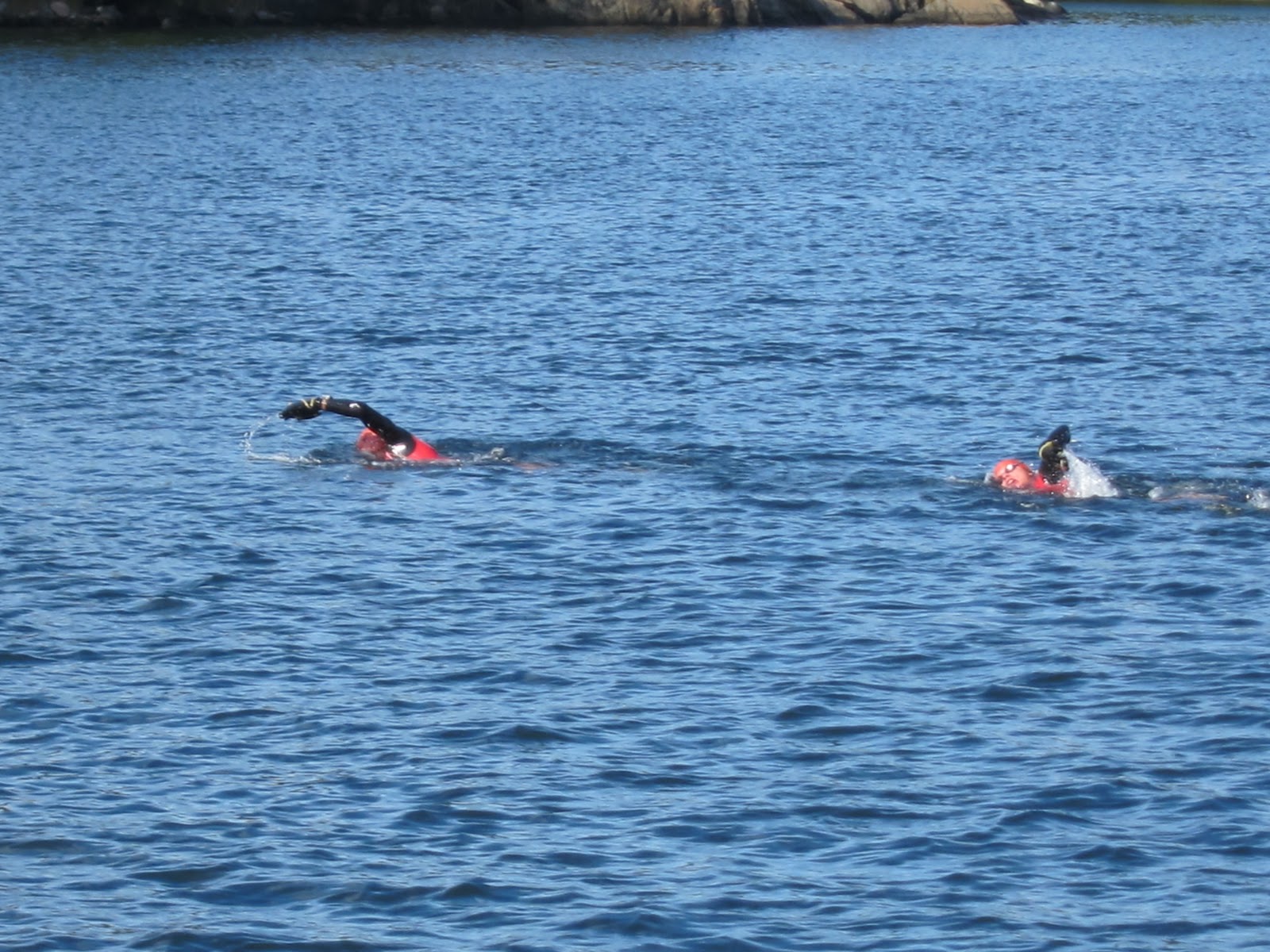
ÖtillÖ claims to be one of the most difficult one day races in the world, and at first glance, one can understand why - just from the distances alone. Further investigation reveals how one actually participates: fully decked in a wetsuit, usually altered - with the legs cut off at the knees, running shoes, and a backpack - to carry supplies - all of which make many races pale in comparison. Then consider (1) the environment in which the event is held: in the Swedish archipelago and the Baltic Sea, (2) the terrain: 19 rugged islands (some inhabited, some not), (3) the distance: 54 km running and 10 km swimming and (4) the water temperature: between 10 and 16 degrees Celsius (50 – 60 degrees Fahrenheit). The combination of all these factors makes for a challenging race well before the start gun has even gone off.

As you can probably imagine, if you’ve never competed in this race, chances are you’ve never done anything like it before, which places you at distinct advantage to those who have previously competed in ÖtillÖ. To further complicate matters, I was in London and Adrian, my teammate, in New York, so training together was not going to be possible. However, we had previously swum in the same Masters class while I was in New York, I knew Adrian was (still is) a very gifted athlete. So, through loose communication, we did manage to follow a similar training / preparation regiment, and we were confident that despite our geographical isolation we’d be ok racing with each other on what was to be the longest race either of us had done by a margin of over 5 hours.

Given Adrian’s strength in swimming (he was close to an Olympic level swimmer back in the day) and both of our running abilities, we thought we had a decent chance at finishing on the podium, but in a race like this (especially when neither participant has done this race), anything can happen over the span of 64 km and 10+ hours.

So here we go....

Day 1 – Road to Saltsjöbaden

My day started in London, and my mom, who was over to watch the race, were due to depart Heathrow for Stockholm - Arlanda at 11:30 a.m. on British Airways. After a smooth trip out to Heathrow, we arrived at our gate and boarded the plane for Sweden.

The 2.5 hour / 908 mile flight went by quickly, and 30 minutes from touchdown, the plane began its descent. As we neared the ground, we could clearly see, unsurprisingly, the landscape had completely transformed from England’s melancholy rolling, green hills to a landscape riddled with lakes, the Swedish red, timber farmhouses and evergreen trees stretching to the horizon. On the approach, the intricate web of sea inlets (Stockholm itself sits on 14 different islands) dotted with sailboats came into view, and shortly, thereafter we had arrived in Sweden.

To me, the Nordic atmosphere was noticeable as soon as we exited the jet way into the main terminal as the floors were wooden and the design, probably deliberate, was what you’d picture walking through IKEA. Once we worked out where the yellow, high speed Arlanda Express was, we purchased our tickets, which were very expensive (even compared to the Heathrow Express) – welcome to Scandanavia, boarded the 20 minute train to Stockholm centre and were off. Some of the small things I noticed on the way in: (1) Volvos, which are manufactured in Gothenburg, Sweden, and Saabs, which are produced in Trollhättan, Sweden, make up probably 40% (slight exaggeration) of the cars, (2) loads of blond people and (3) the little red cottages are EVERYWHERE.

The plan for the day was to take the Arlanda Express to Stockholm Central station, and from there, take a train to Saltsjöbaden, which is approximately 30 minutes outside Stockholm on the edge of the archipelago and would be where I’d meet up with Adrian and several others racing ÖtillÖ. Of course, much easier said than done.

When we arrived at the central station, it was immediately apparent that it wasn’t going to be a straightforward transfer to the Saltsjobaden train as the board announcing departures and  corresponding platforms was devoid of any reference to Saltsjobaden. So, I tried using one of the information kiosk computers to figure out which train we were supposed to catch, but after changing the language from Swedish to English and running a search, all the results came back in Swedish. Needless to say, this was a dead end.

So, we finally acquiesced and decided to ask for help. Being in Sweden, I thought getting help, in English, was going to be very easy. Turns out, we had to speak to three people before we found someone who spoke English. Maybe they didn't feel like talking to tourists...it worked. After grossly mispronouncing Saltsjobaden (i.e. at first, they had no clue as to which town I was talking about), a lady offered to help. Unfortunately, the directions we were given were not clear at all – only another place was mentioned – Slussen. Eventually we realised we needed to take the Tunnelbana, the Stockholm metro, to Slussen station and take the commuter train to Saltsjobaden.

Sure enough, we caught the Tunnelbana to Slussen, as soon as we exited the train we saw signs for Saltsjobaden. All in all it took us over an hour from our arrival in Stockholm Central to get to where we currently stood – all of which should have taken 15 minutes. The train looked very different from what I expected – which was sleek, modern and efficient. However, the sight before us couldn’t have been more the opposite. Blue, probably 40 years old, retro-clothed seats and what you’d expect to board on a trip in the middle of Siberia, but...it ended up being a very cool commute.

The train ride proved to be a very casual crawl along Stockholm’s harbour, then through the verdant suburbs, frequently crossing bike paths and local schoolyards. With the windows open and being a comfortable 15 degrees C (c. 60 degrees F), the 18 km journey was refreshing. We could tell we were closing in on the coast as we passed numerous pods of sailboats tied to their moorings just offshore from the ubiquitous red cottages dotting the rocky coastline, and shortly afterwards, we arrived at the end of the line.

The Grand Hotel, our residence for the night, is located right on the sea and 200 meters from the end of the line. It's an impressive building in the otherwise quaint town seaside village, and the views of the surrounding harbour and sheltered cove are really nice / serene. The building was built in the 1800's and has been used to host Swedish royal events although I'm pretty sure such events were held a long time ago as the building is showing signs of age. But, the location is spectacular. Our hotel room was probably one of the best in the entire place as we had a corner room with 4 large French doors facing out to the harbour below, so the trip had definitely begun on a positive note.

Once we checked into the hotel, I met up with Adrian to catch up and begin disussing our tactics for the race. I also wanted to jump in the water to get a feel for the temperature as this had become my biggest concern, especially given the coldest water I'd swam (for a material amount of time) in was about 17 degrees. As I previously mentioned, the sea temperature in the archipelago ranges from 10 - 16 degrees, and when your body has been going for 8 hours, it can struggle to maintain a safe core temperature - hence my nervousness. So, Adrian and I walked out around a small island in front of the hotel  and I found a good place to jump in. With the wetsuit on, I slowly slid down the slippery rocks into the Baltic. As the water entered the wetsuit and my face hit the water, there was definitely a bit of a jolt, but not the pain which usually accompanies really cold water. But the more bizarre discovery was the salinity of the sea.

Usually, when you jump into the ocean, you can taste and feel the salt; however, here, there was only a very faint trace of salt - so faint, there was a negligible increase in buoancy - like swimming in a large freshwater lake. So, I did and little research and sure enough "low salinities occur in polar seas where the salt water is diluted by melting ice and continued precipitation. The Baltic Sea ranges in salinity from about 5 to 15 o/oo (or parts per thousand)" whereas "the salinity of the ocean water off Miami Beach, Fla., varies from about 34.8 o/oo in October to 36.4 o/oo in May and June." Furthermore, "the salt content of the open oceans, free from land influences, is rarely less than 33 o/oo and seldom more than 38 o/oo." So based on the above, the water we were swimming in was very unique compared to most oceans in the world. So unique I was told, that if absolutely necessary, one could drink the sea water and hydrate themselve. Interesting stuff....

Anyway, I swam out into the clear, dark blue sea under the setting sun, and, as I continued out, my body became accostomed to the cold and began to relax. Wow....what a great feeling - being out in the crisp, blue Baltic, under a beautiful Scandanavian sky, and with stunning terrain in every direction. From that point on, I knew that ÖtillÖ was going to be epic.

That night we ate at the hotel's harbourside restaurant, and I'll have to say the waitstaff serving our section lived up to the Swedish stereotype. Wow.

After a steak dinner and a few glasses of wine, I was beat and didn't last long. The following day was going to be a long one - race preparation, transfer to Sandhamm - starting point of the race and team check-in.

Day 2 – Off We Go - Sandhamm

After an early wake up and breakfast, Adrian and I met up to make sure we had all the mandatory gear (ÖtillÖ requires madatory items like compass, medical bandages, GPS, etc) as well as our personal gear. Since it was our first time doing this race, a substantial amount of our preparation was guess work based on our SWICK experience (instead of triathlon BRICK - bike then run workout - ÖtillÖ training is a SWICK - swim - run). My training had been in the Thames near Oxford and Adrian's in the Hamptons. Both far cries from the Swedish Archipelago.

ÖtillÖ is a tricky race to prepare for given the participants run in wetsuits, have to bring fluids and nutrition for the distances between the feed stations, and the fact there are no specific rules prohibiting swim aid equipment (other than motorized devices - i.e. fins, paddles, buoys and even rafts are permitted). So then the question becomes, do we want to go light and fast, which means you'll reduce drag in the water by using a small waist pack or backpack, or safely prepared, which may mean a large backpack with plenty of supplies, maybe fins, and paddles. How much drag you create is a critical decision in this race owing to the amount of time spent in the water. Swimming 10 kilometers alone is a daunting task, and swimming 10 kilometers while running 55 kilometers makes the task almost scary with the cumulative exhaustion (from swimming, running, entering and exiting the water, climbing up the rocks, etc.).

Another consideration is the 38 “transitions” or “ins and outs” between the 19 islands. Speed is key because taking a minute longer, which is small on its own, than your competition will cost you almost 40 minutes, which is a large gap. So with that in mind, Adrian and I opted for the light and fast approach mainly to avoid creating too much drag in the water, and we figured with aid stations every hour we'd be ok with a small water bottle and 5 or 6 gels (along with the mandatory gear).

After running through our strategy and discussing the race course and map, we went through our gear checklist, which was the following:
  • wetsuit - below the knee cut off to allow for better flexibilty when running
  • neoprene cap - we figured this would be helpful later on in the race when our bodies were struggling to keep warm from the exhaustion. Plus the water is cold anyway...
  • neoprene gloves - rationale similar to the neoprene cap
  • waist pack - for each one us - these would carry our gels, mandatory gear, inlcuding map waterproof phone, and one 3 oz water bottle
  • swimming paddles - small 
  • compression socks
  • shoes - which are kept on the whole race (i.e. swam in)
  • vaseline - lots of it to reduce chaffing
Once we had made sure we had all the right gear, it was time to grab our stuff and head out to Saltsjobaden's ferry dock to catch the ÖtillÖ ferry, which left at 12:30, out to Sandhamm. We decided to grab a quick bite at the local cafe (the vegatable lasanga was amazing!), and subsequently followed the trickling of  ÖtillÖ athletes to the ferry. When we arrived at the dock, the ÖtillÖ staff were there to greet everyone and welcome them to the race as the boat was specifically reserved for the 160 ÖtillÖ participants which was pretty cool. Our friends and family would stay in the Grand Hotel one more night, and a pre-arranged boat was to pick them up the next morning to follow and spectate the race. So, the boat was loaded with tough looking Scandanavian types and tons of duffel bags, and you could sense the anxiety hovering in the air. With the main cabin full, our group headed to the roof for the one hour and forty five minute journey out to Sandhamm. 

The day was perfect - sunny with a breeze blowing off the sea. As we cruised out into the channel, we were able to more clearly see the challenging terrain we were to encounter the next day. The islands and their beaches are rocky with dense vegetation, and at some places, the crest of the island was 20 or 30 meters above the sea  - not exactly flat or a straightforward crossing. The scenery was really amazing. There were also sailboats everywhere, and when I made the comment about the number,  someone said that Stockholm alone had over 750,000 boat registrations alone (with a population of just under 1.2 million). Although I can't verify that number, Sweden does have one of the highest numbers of boats per capita in the world.

About an hour out from the harbor, we could see some of the islands we'd be crossing. Some up to 10 miles long others only 200m. All beautiful but to be running across and swimming in between them was going to be another story. We'll would soon find out.


After about an hour and forty five minutes on the ferry, we arrived at Sandhamm, a small, natural port in the archipelago with easy access to the Stockholm. Sandhamn has been popular for  boating since the late 19th century. It is known for its tavern, its clubhouse, and, not the least, its harbour, which was very picturesque. The ferry docked, and all 180 or so people exited the boat on the way to race preparation area to gather race bibs, GPS, waterproof cellphones, have equipment checked, grab hotel key, etc. etc. The ÖtillÖ race had essentially taken over this small town of 108 people. The one hotel, which is very, very cool, was completely filled with ÖtillÖ athletes.

The next activity for the day was to run out to the first swim, get a little practice in, and run back in time for the race briefing at 5:30 p.m. So, after grabbing all our gear, checking in, we slipped on the wetsuit, shoes and ran out to the first swim, which was the longest of the race 1600m, to just get a feel for water. It was fantastic! Run out and the water felt great - the first swim was across a large channel and while swimming we saw cruise ships and huge fishing vessels passing through as we swam out - very cool to see.

By the 5:30, everyone had gathered in the Sandhamm hotel's restaurant / bar area, which was in a large atrium overlooking the harbour outside adorned with all kinds of fishing memorabilia, for the official race briefing from the two guys in charge of running the race - Mats Andersson and Michael Lemmel. To begin the race overview, they prefaced with the history of the race, which, as with many similar ultra-distance races, began as a drunken bet. Apparently four guys, who still race ÖtillÖ every year made a bet that they could not make the passage from Uto to Sandhamm - period. However, a pair did - in about 36 hours - sleeping on mosquito infested islands (which we would experience the following day!) - asking island residents for food and water - and risking being overrun by boats during the 19 swims....a much more daunting task given no trail markings or race officials controlling boat traffic.

Once the race briefing ended, the athletes were treated to a massive dinner, which was definitely needed. We scarfed down several plates of the delicious pasta and spoke to several of the other athletes at our table - most of which had already participated in the race. Once dinner concluded, I decided to grab a few beers with my English training partners, and shortly thereafter, headed back to the room to put together the final race preparations and get to bed as the race was to start at 6 a.m. the following day with breakfast at 5 a.m.

Day 3 – Race Day


The day had finally arrived....this had been the moment we'd been preparing for over 6 months with intense, long training sessions, but I couldn't wait to get started and actually see what this race was all about.

Adrian and I were out of bed at 4:30 to for breakfast....put down a load of calories, went back to the room, I covered myself in vasoline (to prevent chaffing), suited up and off we went to the staging area. Upon exiting the front of the Sandhamm hotel, we entered a sea of neoprene and jittery conversations. The sky was coloured with deep oranges and reds with the imminent arrival of the sun in the south-eastern sky, and with about 5 minutes to go, we all were moved to the starting straight.

With a final, brief "good luck" and "enjoy the race," the race was about to begin. As we entered the final minute before the race, a filming helicopter appeared over the harbour, and BOOM....we were off...for a LONG day.

As with almost all races, the beginning starts off at a lightening pace and this one was no different. For the first mile, which is the distance to the first swim, we clocked about a 6:30 pace (per mile), but once the first and longest swim of the day started, the field began to spread and the pace slowed.

After about a 25 minute crossing of the channel, Adrian and I arrived at the first exit, which, as we had been told, was (as with the remaining 18 exits) not exactly a straightforward process. With paddles on your hands / cold water and algae covered rocks, extracting yourself from the water was a delicate, tricky process, and the movements / positioning required were slightly concerning as these were exactly the kinds which are prone to cramping, especially in the latter portions of the race. So, with that being said, once we reached the first island, the swim exit was a morass of flailing arms, unstable, contorted athletes attempting to wrench themselves from the 14 degree sea. After falling on my face a few times, I managed to crawl out of the water for the first run of the day.

This was going to be interesting part for me as the race description stated the island crossings were "trail runs," but we'd heard from other athletes who'd participated in the race, most of the time spent on the islands would be on unwieldy, ankle breaking trails strewn with loose rocks, covered in slippery moss, fallen trees, dense vegetation and large slabs of rock. The first island crossing was only a glimpse of what was to come later in the race. It was up and down rocky outcroppings, jumping from ledge to ledge, slithering under fallen trees, and dodging whipping branches...all of which expended far more energy than the usual trail run. But hey.....it was fun as hell and definitely an exhilarating experience, especially with the helicopter hovering overhead.

As the race progressed and the drone of the helicopter faded, the field eventually would spread to almost 8 miles, especially given that some athletes were not expected to cross the finish line until 9 p.m. that night with the winning team crossing about 3 p.m.. For the first four hours, Adrian and I kept a solid pace and were in the first 10 teams, and we were both feeling strong - making sure we adequately refuelled at the aid stations (i.e. pounding Red Bull, eating cinnamon buns, hot dogs to even drinking cup after cup of beef bullion - probably the best thing on the entire course since your body is completely depleted of salt). Runs felt steady and the swims were actually a refreshing cool down from the long, 1 hr+ runs; however, this would change in the latter half of the race.

At around the 4 1/2 hour mark, Adrian started to feel pain high in his  upper quadracep and had to slow down to prevent further aggravation, but we still managed to hold decent pace. However, with each additional step / ascent / decent of a rock outcropping, the pain worsened to a point where our island crossings were done at a walk. But, we were still moving....

At this point, our "race" ended (i.e. Adrian and I wanted to try and podium the race), but we were going to do all we could to ensure that we finished the race. Fortunately, we had made significant progress in the first 5 1/2 hours as evidenced by the fact that other athletes trickled by us for the next 7 hours - right up to the finish line on Utö. So, we slowly walked the remainder of the race, and given that I felt ok (tired yes but not in excruciating pain), I was able to take in the stunning scenery of the course - dotted with red cottages, green fields, beautiful forests, rocky coastlines and stunning views of the ever present Baltic sea with the downside being the cold water slowly began to take its toll on our bodies. Since we weren't heating ourselves up on the runs (i.e. were walking), the cumulative effect of the cold water and muscle fatigue began to really wear us down towards the final hours. The cold water over our legs, which were filled with lactic acid, made each water exit and the island crossings more painful not to mention making our body temperature drop to a point in which we were shivering.

But the end was in sight....after 5 hours of an honest push and 8 hours of a slog towards the finish line. With the deepening shadows and sun approaching the horizon, we reached Utö, the final island. We had been giving a small taste of the encroaching mosquitoes on the previous island crossings, but on Utö, we were absolutely swarmed. Since our pace was at a walk, we were a welcome target for the bloodsuckers. Shit - I hate mosquitoes, and we were eaten alive for the last 2500 meters. The finish line could not appear fast enough.

Finally, after 30 minutes, the end was in sight, and shortly thereafter, we reached the end. What a day! Exhausted, hungry and ready to get the damn wetsuit off....we briefly spoke to our friends and family and quickly retired to the hotel room to shower and to get ready for the closing ceremonies / feast, which were fantastic...although, I could barely keep my eyes open after dinner.

The next 24 hours were spent feeling like I had been beaten with a baseball bat...but in a good way. Love the feeling...of accomplishment.

Day 4 – Stockholm and Return


Today was spent slowly making our way back to London by starting at Utö, 1 1/2 ferry to Saltsjobaden, train from Saltsjobaden to Stockholm, quick tour of Sweden's capital, and flight back to London. All walking done with a limp.

What a trip....